When your federal student loans enter repayment, the repayment plan you choose determines your monthly payment, total interest, and whether any remaining balance will be forgiven. Federal student loans offer multiple student loan repayment plans, from the 10-year Standard Plan to income-driven repayment (IDR) options. Since no single plan works for everyone, this guide compares the choices and explains when each plan makes sense.
How Federal Student Loan Repayment Plans Work
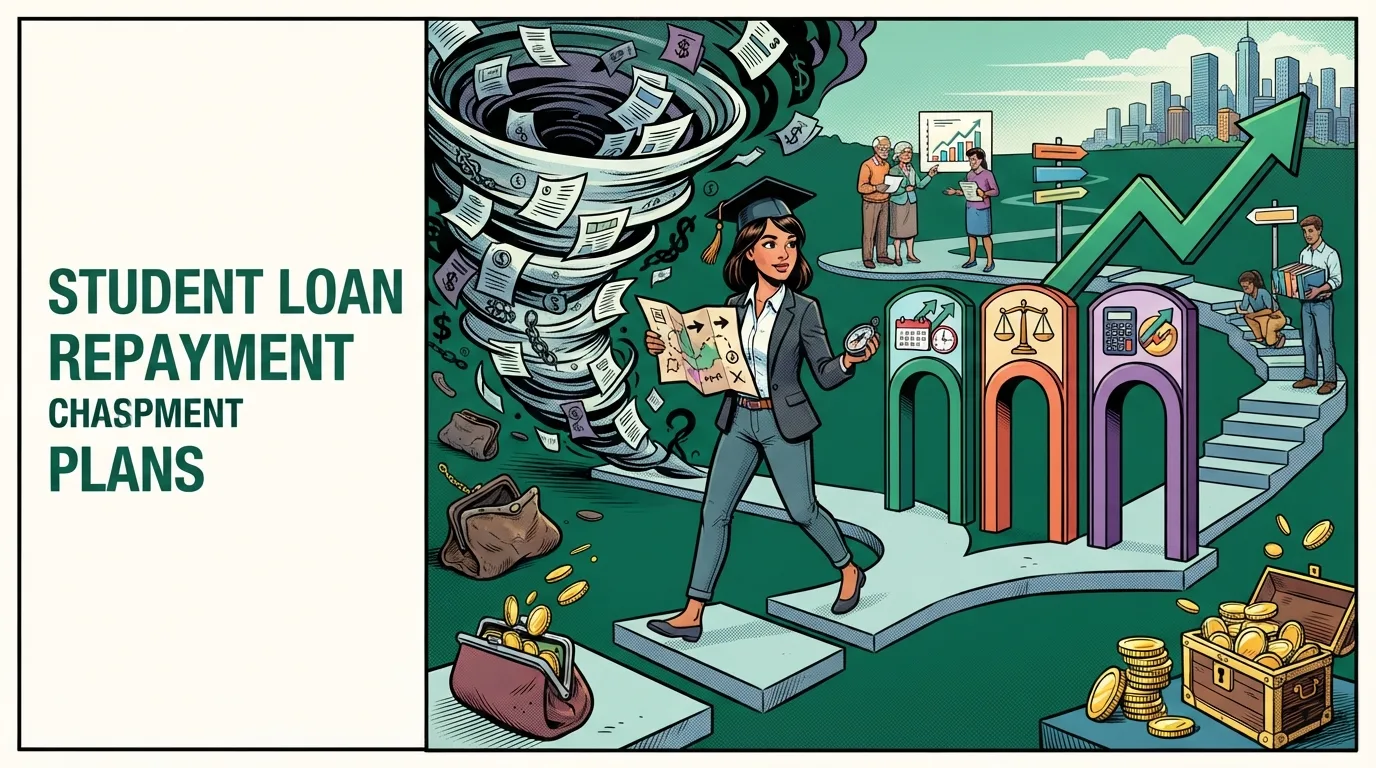
Federal student loans are repaid under one of several statutory repayment plans. Your loan servicer applies your selection to your loans. If you do not choose a plan, you are placed into the Standard Repayment Plan by default. Most borrowers can change plans at any time, so you are not locked into your initial choice.
Key facts to keep in mind:
- Standard-style plans set your payment according to your loan balance and a fixed timeline. They do not use your income.
- Income-driven repayment (IDR) plans set your payment using income and family size and can forgive unpaid balances after 20 or 25 years, but may increase total interest.
- Repayment terms range from 10 years to as long as 30 years for some consolidation loans.
Standard, Graduated, and Extended Plans at a Glance
These plans do not take your income into account. They repay according to a set schedule, and your monthly amount is based on your loan balance and interest.
| Plan | Repayment term | Monthly payment | Typical borrower | | --- | --- | --- | --- | | Standard Repayment Plan | Up to 10 years | Fixed | Borrowers who want the lowest total interest cost and can handle the payment | | Graduated Repayment Plan | Up to 10 years | Starts lower and increases every 2 years | Early-career borrowers who expect steady income growth | | Extended Repayment Plan | Up to 25 years | Fixed or graduated | Borrowers with more than $30,000 in outstanding Direct Loans |
Note: A Direct Consolidation Loan can extend these repayment terms up to 30 years, depending on the amount owed.
Compare the Four Income-Driven Repayment Plans
IDR plans calculate your payment using discretionary income, which is generally your adjusted gross income minus a percentage of the federal poverty guideline for your family size. The four IDR plans differ in formula, eligibility, required payment, and forgiveness timing.
- PAYE (Pay As You Earn): Your monthly payment is 10% of discretionary income above 150% of the poverty line and never exceeds what you would pay under the 10-year Standard plan. Remaining balances are forgiven after 20 years. PAYE is only available to borrowers who were new on or after Oct. 1, 2007, and had at least one Direct Loan after Oct. 1, 2011.
- IBR (Income-Based Repayment): New borrowers on or after July 1, 2014, pay 10% of discretionary income above 150% of poverty and receive forgiveness after 20 years. Older IBR borrowers pay 15% of discretionary income and receive forgiveness after 25 years. IBR payments are capped at the 10-year Standard amount.
- ICR (Income-Contingent Repayment): Your payment is the lesser of 20% of discretionary income above 100% of poverty or a fixed 12-year payment amount. Forgiveness occurs after 25 years. ICR is the only IDR plan available to parent PLUS borrowers who consolidate their loans.
- SAVE (Saving on a Valuable Education): SAVE replaced REPAYE and originally offered lower payments based on income above 225% of poverty, with separate rates for undergraduate and graduate loans. Because of legal challenges, new SAVE enrollments are paused as of mid-2025, and borrowers in SAVE are in an interest-free forbearance. Check current federal guidance before applying.
Choosing the Right Plan for Your Situation
No single plan is best for every borrower. Ask yourself these questions:
- Can you afford the Standard Plan payment? If yes, choose it. Standard payments are fixed, your loans are gone in 10 years, and it generally costs the least in total interest.
- Do you need a smaller monthly payment? An IDR plan such as PAYE or IBR may be the best fit when your income is modest compared with your loan balance. Remember that the lowest payment may not cover accruing interest, so your balance may grow before forgiveness.
- Are you pursuing Public Service Loan Forgiveness? Make 120 qualifying payments while working full time for a qualifying employer, and the rest of your balance may be forgiven tax-free. An IDR plan is the most common way to keep those payments affordable.
- Do you have a very high balance? The Extended Plan spreads repayment over 25 years, which lowers monthly payments but increases total interest substantially.
- Is your income expected to grow quickly? A Graduated Plan gives you lower payments now with scheduled increases, but it almost always costs more than Standard over time.
Since you can switch student loan repayment plans at any time, monitor your plan annually. If you are on an IDR plan, recertify your income and family size every year. Missing recertification can cause your monthly payment to jump to the 10-year Standard amount.
How to Apply for a Student Loan Repayment Plan
Before applying, use the Department of Education Loan Simulator at StudentAid.gov to compare estimated monthly payments and total cost across every plan you may qualify for. Once you choose, submit an application online through your loan servicer or complete the official IDR application on StudentAid.gov. Your servicer will process the request and provide your new repayment schedule. If your income or family size drops during the year, you can request an early recalculation instead of waiting for recertification.
Bottom Line
Your student loan repayment plan affects your monthly budget, total interest costs, and eligibility for forgiveness. Pick a plan that aligns with your income, career path, and debt level. If your financial situation changes, revisit your choice. The right plan for you now may not be the right plan five years from now.