
Fixed vs Adjustable Rate Mortgages: Which Home Loan Is Right for You?
When you apply for a home loan, one of the first and most consequential decisions is whether to choose a fixed-rate mortgage (FRM) or an adjustable-rate mortgage (ARM). Both can help you buy a home, but they structure interest rates and monthly payments differently. Fixed vs adjustable rate is not about which is objectively better—it's about which fits your financial situation, risk tolerance, and how long you plan to stay in the home. This guide breaks down how each loan works, the trade-offs, and a practical framework for making your choice.
What Is a Fixed-Rate Mortgage?
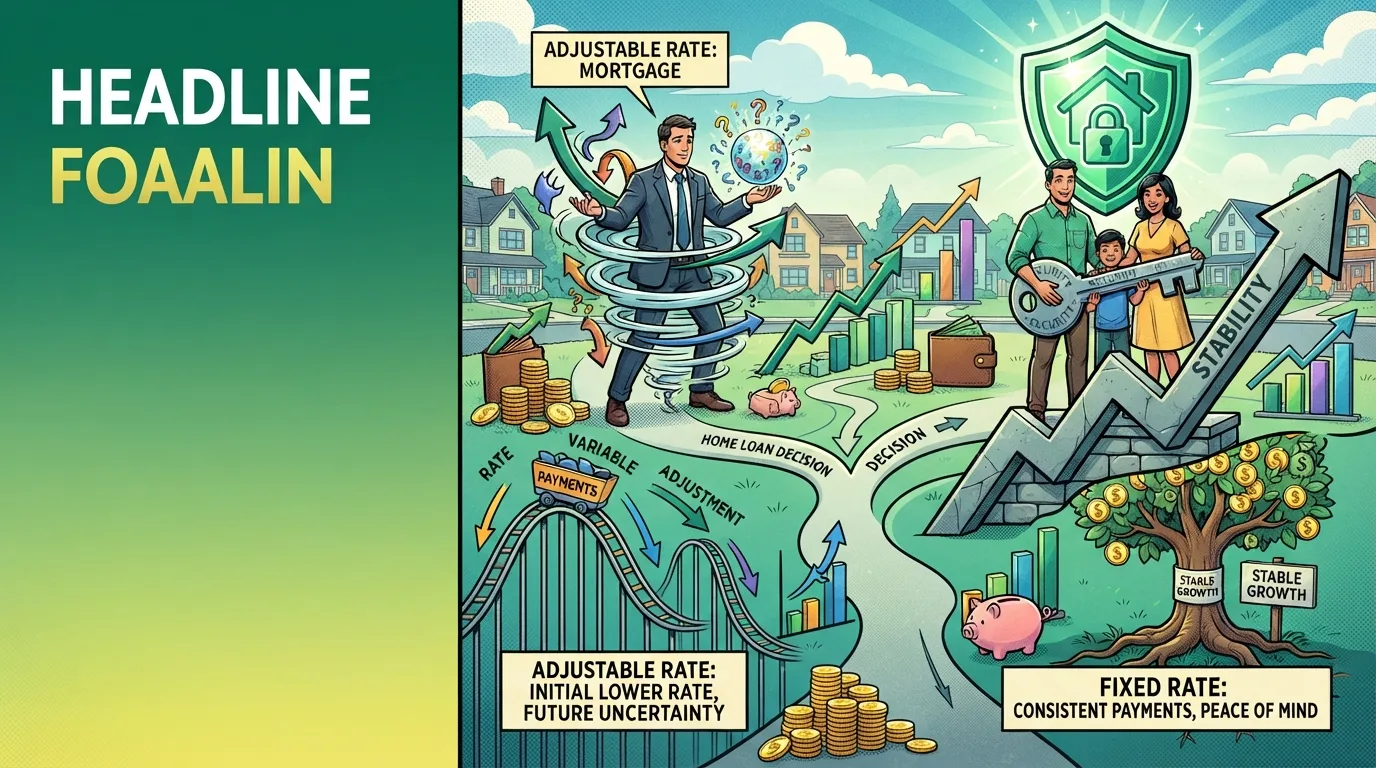
A fixed-rate mortgage charges the same interest rate for the entire loan term, so your principal and interest payment stays constant. The most common terms are 15-year and 30-year fixed loans, though 10-year and 20-year terms are also available.
With a fixed-rate mortgage, your monthly payment may still change slightly due to escrow adjustments for property taxes and insurance, but the loan's interest rate never changes. That stability makes budgeting easy and eliminates payment shock from rising rates.
Pros:
- Predictable monthly principal and interest payments.
- Protection from future interest-rate increases.
- Simpler to understand and compare across lenders.
Cons:
- Usually starts with a higher interest rate than an ARM's initial rate.
- You won't benefit if market rates fall unless you refinance, which costs money.
- If rates drop significantly, you may feel locked into an above-market rate.
What Is an Adjustable-Rate Mortgage?
An adjustable-rate mortgage has an interest rate that changes periodically. A typical ARM is described by two numbers, such as 5/1. The first number is how many years the initial fixed rate applies; the second is how often the rate adjusts after that. So a 5/1 ARM stays fixed for five years, then adjusts once per year.
After the initial period, the ARM's interest rate is calculated using a benchmark index plus a margin. Common indexes include the Secured Overnight Financing Rate (SOFR) and the Constant Maturity Treasury (CMT) rate. The margin is a set number of percentage points that the lender adds. For example, if the SOFR is 4.25% and your margin is 2.75%, your new rate would be 7.00% at the next adjustment.
ARMs are protected by rate caps that limit how much the rate can change. A typical 5/1 ARM might have a 2/2/5 cap structure: the first adjustment can increase or decrease by no more than 2 percentage points, each subsequent annual adjustment can move by up to 2 points, and the rate can never be more than 5 points above the initial rate over the life of the loan. Caps reduce but do not eliminate payment risk.
Pros:
- Lower initial interest rate compared to a fixed-rate mortgage, often by 0.5 to 1.0 percentage point.
- Lower initial monthly payment, which can help you qualify for a larger loan or free up cash.
- You can benefit if interest rates decline in the future.
Cons:
- Monthly payments can increase significantly after the fixed period ends.
- Complexity makes it harder to predict lifetime borrowing costs.
- For long-term homeowners, an ARM can become more expensive than a fixed-rate loan.
Key Differences: Rate, Payment, and Risk
| Characteristic | Fixed-Rate Mortgage | Adjustable-Rate Mortgage | | --- | --- | --- | | Interest rate | Never changes | Changes periodically after initial fixed period | | Payment stability | High | Lower, because rate can move | | Initial rate | Higher | Lower | | Long-term cost | Usually more predictable | Can be lower or higher, depending on market | | Rate caps | Not applicable | Yes, limits on adjustment size | | Best for | Long-term occupancy | Short-term occupancy or expected rate decline |
The risk profile differs mostly on time horizon. If you plan to stay in a home for 10 years, a 30-year fixed loan gives you certainty over the entire decade. With a 5/1 ARM, your rate is guaranteed for only the first five years; after that, it is uncertain, and your worst-case payment is determined by the caps. The trade-off is that the ARM saves money upfront, and if rates stay low or you sell before the adjustment, you come out ahead.
Who Should Choose a Fixed-Rate Mortgage?
A fixed-rate mortgage is generally the safer choice when:
- You plan to stay in the home for more than 7–10 years.
- You prefer predictable monthly expenses and don't want to monitor rate movements.
- You're buying at a historically low interest-rate environment and want to lock in that rate.
- Your budget is tight and a payment increase could jeopardize your finances.
For example, a first-time buyer on a modest budget with a 30-year fixed rate at 6.5% knows their principal and interest payment won't change. Even if inflation drives rates to 9% a few years later, the mortgage payment is unaffected. That peace of mind is valuable, and it simplifies long-term financial planning.
Who Should Choose an Adjustable-Rate Mortgage?
An ARM can be a smart strategic choice when:
- You expect to sell or refinance before the initial fixed-rate period ends.
- You're a high-income borrower who can absorb payment increases without distress.
- You believe interest rates will stay flat or fall in the coming years.
- You want to minimize early costs and invest the savings.
Consider a buyer who plans to live in a home for four years and then relocate for work. A 5/1 ARM with a 6.0% initial rate might cost less each month than a 30-year fixed at 6.5%. Over 48 months, the savings could total several thousand dollars, and the borrower sells before the rate adjusts. This scenario is where an ARM shines.
However, an ARM is riskier if you might not sell as planned. If a job transfer falls through or home values drop, you could face an adjustable payment instead of the fixed payment you originally wanted.
How to Compare Fixed vs Adjustable Rate: A Practical Framework
To decide, run the numbers for both loan types over the longest time you could realistically stay in the home. Follow these steps:
- Get quotes for both loan types from at least three lenders. Ask for the initial ARM rate, the index, margin, adjustment caps, and the fixed-rate rate for the same loan term.
- Estimate the worst-case ARM payment by applying the maximum adjustment caps to your loan balance at the first adjustment date. For example, on a $400,000 loan at 4.5% with a 2% first cap, the rate could jump to 6.5%. Calculate what the payment would be at that rate.
- Compare cumulative costs rather than just monthly payments. Add up all payments over your expected holding period, including closing costs.
- Stress-test your budget for the worst-case payment. If that payment exceeds what you can comfortably afford, the fixed-rate mortgage may be the better choice.
- Consider refinancing costs. If you choose an ARM but rates rise, refinancing to a fixed rate may be expensive and may not be available if your income or home value changes.
Many financial professionals suggest a simple heuristic: if your planned holding period is shorter than the ARM's initial fixed period, the ARM often wins mathematically. If it's longer, a fixed-rate mortgage is usually safer. But always let your personal risk tolerance and cash reserves guide the final decision.
Bottom Line
The choice between a fixed and adjustable rate mortgage comes down to your time horizon, cash flow, and appetite for uncertainty. A fixed-rate mortgage offers permanent stability and is ideal for long-term homeowners who value predictability. An adjustable-rate mortgage offers lower initial payments and can be a powerful tool for short-term owners or those who expect rates to decline—but it carries real payment risk after the fixed period ends.
Before deciding, read your loan documents carefully, understand the index and margin, and run worst-case payment scenarios. No single loan type is best for everyone. Evaluate your own facts, and you can confidently choose the mortgage that aligns with your financial life.
Frequently Asked Questions
What is the main difference between fixed and adjustable rate mortgages?
A fixed-rate mortgage keeps the same interest rate for the entire loan term, so payments stay stable. An adjustable-rate mortgage has a lower initial rate that can change after a set period, which means payments can go up or down based on market rates.
Can an adjustable-rate mortgage become more expensive than a fixed-rate mortgage?
Yes. After the initial fixed period, an ARM's interest rate can adjust upward according to its index, margin, and rate caps. In a rising-rate environment, the ARM's rate can exceed the initial fixed rate you were offered, making the total cost higher than a fixed-rate loan.
How often do adjustable-rate mortgage rates change?
It depends on the ARM's structure. A 5/1 ARM adjusts annually after five years, while a 7/1 or 10/1 ARM adjusts annually after seven or ten years. Some ARMs adjust every six months. Your loan documents will specify the adjustment frequency and caps.
References