How to Pay Off Debt: A Step-by-Step Guide to Becoming Debt-Free
If you're carrying credit card balances, student loans, or a personal loan, you're not alone. The Federal Reserve Bank of New York reported that total household debt in the U.S. reached a record $17.5 trillion in late 2023. But carrying debt isn't just a statistic—it can weigh on your mind, limit your choices, and cost you hundreds or thousands in interest each year. The good news: there are proven, systematic ways to pay off debt and take back control of your finances. This guide walks you through the entire process, from getting a clear picture of what you owe to choosing a payoff strategy, optimizing your budget, and staying motivated until you make your final payment.
Know Exactly What You Owe
Before you can create a payoff plan, you need a complete, accurate inventory of every debt you have. Most people underestimate their total debt and overestimate their monthly payments. Start by listing all of your debts in one place—a spreadsheet, a notebook, or an app can work.
For each debt, record the following:
- Creditor or lender (e.g., Capital One, Sallie Mae, Wells Fargo)
- Total balance (what you still owe today)
- Annual percentage rate (APR) (the interest rate plus any fees)
- Minimum monthly payment
Due date (to avoid late fees and credit score damage)
Don't forget "hidden" debts like medical bills in collections, store-brand credit cards, or money you've borrowed from family. Once you have your list, add up the total. You should also calculate the weighted average interest rate by multiplying each balance by its rate, adding those together, and dividing by the total balance. Knowing this number helps you compare strategies and see how much you're paying annually just to service the debt.
As you gather this information, check your credit reports. You can get free weekly credit reports from AnnualCreditReport.com during the federal COVID-19 emergency period, but the standard is still one free report from each of the three major bureaus (Equifax, Experian, and TransUnion) every 12 months. Look for any inaccuracies that could inflate what you owe or hurt your credit score.
Choose Your Payoff Strategy: Avalanche vs. Snowball
Once you know your debts, you need a system for deciding which debt to attack first. Two popular methods dominate personal finance advice: the debt avalanche and the debt snowball. Both require you to make the minimum payment on every debt, then put any extra cash toward one target debt. The difference is how you choose that target.
The Debt Avalanche Method
- List debts from highest APR to lowest APR.
- Send extra money to the debt with the highest interest rate first.
- Once it's paid off, roll that full payment into the next highest-rate debt.
Mathematically, this method saves the most money in interest because it reduces the balances that are costing you the most. For example, if you have a credit card at 24% APR and a student loan at 5% APR, every dollar you put on the credit card avoids 24% annually, while paying the student loan only avoids 5%. The avalanche method is the fastest and cheapest path to debt freedom.
The Debt Snowball Method
- List debts from smallest balance to largest balance.
- Put extra money toward the smallest debt first, regardless of interest rate.
- Once it's paid off, roll its full payment to the next smallest debt.
This method focuses on psychology. Small, quick wins can motivate you to keep going. When you pay off a $300 medical bill in the first month, you feel a rush of accomplishment that helps you stay disciplined for the longer journey. Some research suggests that people who use the snowball method are more likely to stick with their debt repayment plan than those who use the avalanche method, even though the math is less optimal.
If you're torn, consider a hybrid: use the avalanche method but choose your top target based on a balance that also feels attainable. For many people, attacking a mid-sized, high-interest card first gives both the emotional boost and the financial benefit.
Build a Debt Payoff Budget and Free Up Cash
Paying off debt faster isn't just about choosing a method—it's about freeing up more money to throw at your balances. That means you need a realistic budget that accounts for your essentials but also creates a "debt payoff" line item above the minimums.
A simple framework is the 50/30/20 budget: 50% of your take-home pay goes to needs (housing, utilities, groceries, insurance, minimum debt payments), 30% goes to wants (dining, streaming, hobbies), and 20% goes to savings and extra debt payments. If you want to aggressively pay off debt, you might shift that ratio to 50/20/30, putting 30% toward debt.
To find the extra cash, start by tracking every dollar you spend for 30 days. Apps like Mint, YNAB, or even a simple notebook can reveal where your money goes. You'll likely spot subscriptions you forgot about, gym memberships you never use, and daily coffee purchases that add up to $100 a month.
Cutting expenses is not about deprivation; it's about redirecting money to a goal that matters more. For example:
- Cancel unused subscriptions and negotiate cable/phone billing (call and ask for promotions—it works more often than you'd think).
- Cook at home four or five nights a week instead of ordering delivery.
- Use a library instead of buying books/audiobooks.
- Switch to generic brands for groceries and household supplies.
- Reduce energy costs by changing your thermostat a few degrees and using LED bulbs.
On the income side, consider a temporary bump. A side hustle—delivering food, freelancing, pet sitting, selling unneeded items on eBay or Poshmark—can generate an extra $200–$500 a month. Apply that full amount to your target debt. Even better, whenever you receive a windfall like a tax refund, work bonus, or birthday cash, put at least 80% of it directly toward your debt. A $1,000 bonus applied to a 20% APR card saves you $200 in interest over the next year.
Reduce Interest Costs and Avoid New Debt
While you're paying off existing debt, you also want to lower the cost of carrying it. High-interest credit cards can easily exceed 25% APR, making it difficult to make real progress. Explore these proven options:
- Call your creditors. Explain your situation and ask for a lower interest rate. If you've been a reliable customer, lenders sometimes offer a hardship plan or a reduced APR for a period. Even a 3-percentage-point reduction can save hundreds per year.
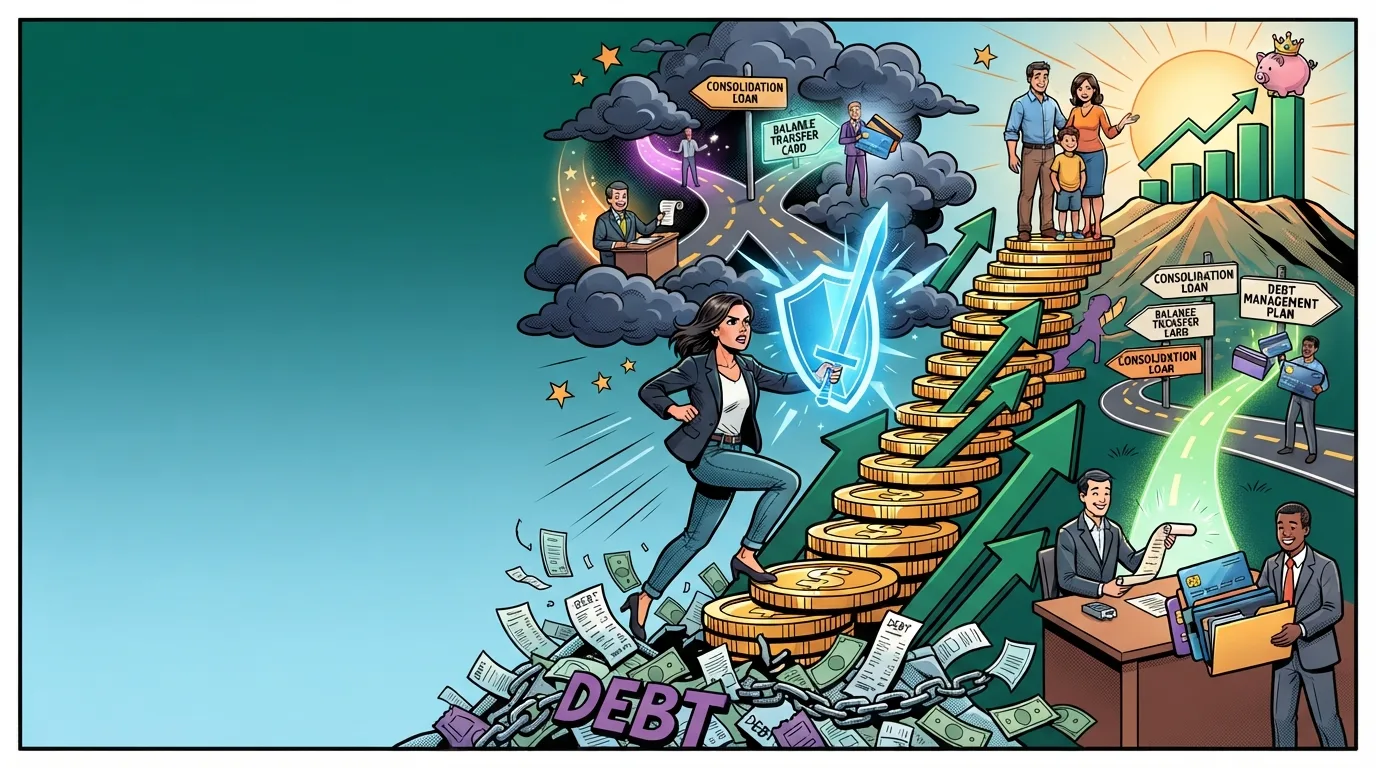
- Balance transfer credit cards. Many cards offer a 0% introductory APR on balances transferred for 12–21 months. This can be a powerful tool to stop the interest clock on high-rate debt. But read the fine print: you'll usually pay a balance transfer fee (3% to 5% of the amount transferred), and if you don't pay off the balance before the promo ends, the remaining balance reverts to a variable rate that is often high. Use this strategy only if you can confidently pay it off within the promo window.
- Debt consolidation loans. A personal loan from a bank, credit union, or online lender can pay off multiple debts, leaving you with one fixed monthly payment. This simplifies your finances and may lower your APR if you qualify for a rate below the average of your current debts. However, personal loans typically charge origination fees (1%–8%), and it's easy to run up new credit card balances if you don't stop using them. A consolidation loan works best when combined with a budget and a commitment to not accrue new debt.
- Credit counseling. A nonprofit credit counseling agency (such as Money Management International or the National Foundation for Credit Counseling) can help you create a debt management plan (DMP). They may negotiate lower interest rates and fees with your creditors. You make one monthly payment to the agency, which distributes it to your creditors. Be wary of for-profit companies that charge large upfront fees for debt settlement—the FTC warns they are often scams.
Whatever route you choose, the goal is to lower the interest rate you're paying while maintaining a realistic plan. Don't consolidate debt if it extends your repayment so long that you end up paying more total interest.
Stay on Track and Avoid New Debt
Paying off debt is a marathon, not a sprint. Most people take two to five years to become debt-free (except for a mortgage). Staying motivated is just as important as choosing the right strategy. Try these tactics:
- Automate your payments. Set up automatic monthly payments for at least the minimum amount on every debt. Better yet, schedule your extra debt payment for the same day you get paid, so you never see the money in your checking account.
- Set visible milestones. Create a printable debt payoff thermometer that you hang on your refrigerator. Color it in each time you pay off a debt or reach a 10% of total balance milestone. Celebrate small victories—without spending money.
- Build a tiny emergency fund. If you don't have any savings, start with a $500–$1,000 buffer. This prevents you from having to use a credit card or loan if your car breaks down or you face an unexpected medical bill. Once you're debt-free, you can grow it to three to six months of expenses.
- Find a support system. Tell a trusted friend or family member about your goal. Join online forums like the personal finance community on Reddit (r/personalfinance) or the Debt Free Community. Sharing your progress and challenges with others keeps you accountable.
- Don't close your old credit cards immediately. Closing a card reduces your available credit and shortens your credit history, which can lower your credit score. Instead, leave them open with a zero balance, and only keep one card for emergency use if you trust yourself.
Finally, prevent new debt as you pay down old balances. This means paying your credit cards in full every month going forward, not using store installment plans, and building a spending plan that you actually stick to. Remember: the goal isn't just to eliminate debt—it's to change the habits that got you there.
Bottom Line
There's no magic bullet for paying off debt, but a disciplined approach works. Start by listing everything you owe, understanding your interest rates, and picking a strategy—avalanche, snowball, or a hybrid. Build a budget that frees up cash, and direct every extra dollar to your targeted debt. Lower your interest costs through balance transfers, consolidation, or negotiating with lenders, but avoid taking on new high-rate debt. And keep your motivation high by automating payments, celebrating milestones, and building a support system. The path to a debt-free life is a series of small, repeatable actions. The best time to start is today—tommorow you'll be one step closer to freedom.
Frequently Asked Questions
What is the fastest way to pay off debt?
The fastest method is the debt avalanche, where you pay extra money toward the debt with the highest interest rate first while making minimum payments on everything else. This minimizes the amount of interest you accrue, so you pay off the total debt more quickly and at lower overall cost. Increasing your income and cutting expenses to make larger extra payments accelerates the process even more.
Should I use a debt consolidation loan to pay off debt?
A debt consolidation loan can be helpful if it lowers your overall interest rate and gives you a single monthly payment. But you should only do it if you have a solid budget and a plan to avoid running up new debt, since many people just re-accumulate credit card balances after consolidating. Also watch out for upfront fees and make sure the new loan term doesn't stretch so long that you pay more in total interest.
What's the difference between the debt snowball and debt avalanche methods?
The debt snowball method focuses on paying off your smallest balance first, regardless of interest rate, to gain psychological momentum. The debt avalanche method focuses on paying off the highest interest rate first to save the most money on interest. Avalanche is mathematically optimal, while snowball may be easier to stick with if you need quick wins to stay motivated.
References