
Traditional vs Roth IRA: How to Choose the Right Retirement Account
Choosing between a traditional IRA and a Roth IRA is one of the most common retirement planning decisions. Both accounts offer valuable tax advantages, but they work in fundamentally different ways. This guide breaks down how each IRA functions, who qualifies, and how to pick the one that aligns with your current tax situation and future retirement goals.
Traditional IRA vs Roth IRA: Key Differences
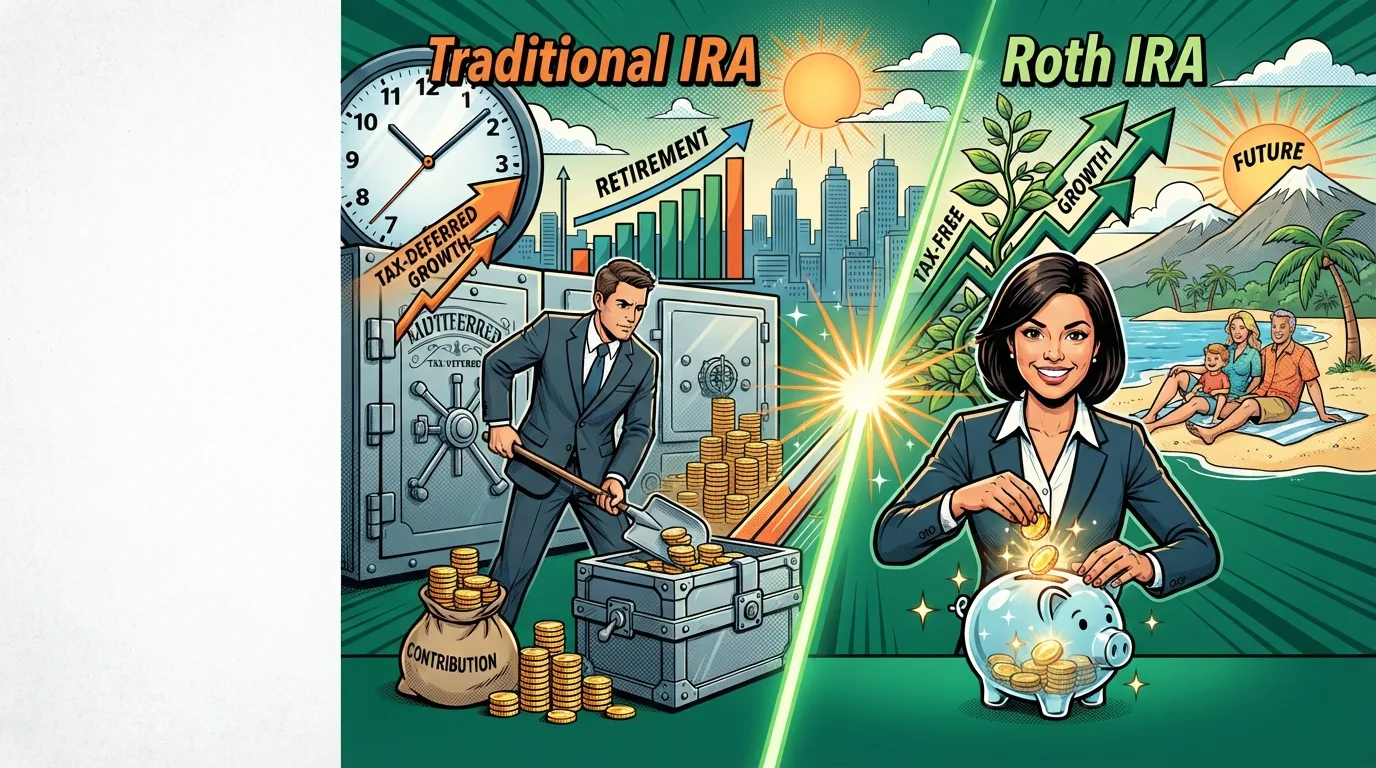
At their core, the difference comes down to when you receive a tax benefit. A traditional IRA provides an upfront tax break—contributions may be deductible on your federal tax return. Your money then grows tax-deferred, and you pay ordinary income tax on withdrawals in retirement. A Roth IRA, in contrast, is funded with after-tax dollars. You get no immediate tax deduction, but qualified withdrawals in retirement are completely tax-free.
Other key differences include:
- Required Minimum Distributions (RMDs): Traditional IRAs require you to start taking distributions at age 73 (under SECURE 2.0). Roth IRAs have no RMDs during the account owner's lifetime.
- Income limits: Roth IRA contributions have income phase-out ranges. Traditional IRA contribution deductibility also has income limits if you or your spouse is covered by a workplace retirement plan.
- Early withdrawal flexibility: Roth IRA contributions can be withdrawn anytime, tax- and penalty-free. Traditional IRA withdrawals before age 59½ generally trigger a 10% penalty, unless an exception applies.
Tax Treatment: The Core Trade-Off
The decision often centers on your tax rate now versus your tax rate in retirement. With a traditional IRA, you save at today's marginal rate, but pay tax later at your future rate. With a Roth, you pay tax today and enjoy tax-free income later.
Consider a $7,000 contribution if you're in the 22% tax bracket. With a traditional IRA, you lower your taxable income by $7,000, saving $1,540 now, but every dollar withdrawn in retirement is taxed. A Roth IRA costs you an extra $1,540 in current tax, but none of your qualified withdrawals—including earnings—will be taxed.
The outcome depends on your future tax bracket. If you expect to be in a higher bracket in retirement, Roth is often attractive. If you expect a lower bracket, traditional may leave more after-tax income. Most retirees have lower income, but tax rates can change, and required distributions may push you into higher brackets.
The longer your time horizon, the more powerful tax-free growth becomes. Investment earnings in a Roth never face tax, while in a traditional IRA gains are taxed upon withdrawal. Over decades, this can create a significant difference in after-tax wealth.
Contribution Limits and Eligibility
For 2025, the annual contribution limit for both traditional and Roth IRAs is $7,000, plus a $1,000 catch-up contribution if you're 50 or older. You can split your contributions between accounts, but the combined limit remains $7,000 (or $8,000 for those 50+).
Income eligibility differs:
- Roth IRA income phase-out (2025): For single filers, contributions phase out between $150,000 and $165,000. For married couples filing jointly, the phase-out range is $236,000 to $246,000.
- Traditional IRA deduction phase-out (2025): If you're covered by a workplace retirement plan, the deduction phase-out for single filers starts at $79,000. For married filing jointly, it's $126,000 to $146,000. If your spouse is covered but you aren't, the range is $236,000 to $246,000.
You can always contribute to a traditional IRA regardless of income, but the deduction may be partial or completely unavailable if you or your spouse participates in an employer plan and your income exceeds the phase-outs. Roth eligibility is stricter—you cannot contribute directly if your income exceeds the limit, though a backdoor Roth conversion may be an option.
These limits are adjusted annually for inflation. Always check the IRS website for the most current numbers before making contributions.
Withdrawal Rules and Penalties
Both IRAs are designed for retirement, so early withdrawals are generally discouraged with a 10% penalty if taken before age 59½, except for specific situations like first-time home purchases (up to $10,000), qualified education expenses, disability, or unreimbursed medical expenses that exceed 7.5% of adjusted gross income.
The Roth IRA offers additional flexibility: you can withdraw your contributions (not earnings) at any time, tax- and penalty-free. This makes a Roth a useful emergency or bridge-fund source in early retirement. Earnings are tax-free if you've met the five-year holding period and are at least 59½, or meet other exceptions.
Traditional IRAs are less flexible. Withdrawals are always taxed as ordinary income, and if you take money before 59½, the 10% penalty generally applies unless you qualify for an exception. Additionally, RMDs force you to begin taking distributions at age 73. This can increase your taxable income and Medicare premiums in retirement, which some savers overlook.
Roth IRAs have no RMDs, allowing your balance to continue growing tax-free for as long as you live. That can be a major advantage for those who don't need the money during their lifetime and want to leave a tax-free inheritance.
How to Choose: Traditional or Roth IRA?
There's no universal answer, but you can weigh these factors:
- Current tax bracket: Higher earners may prefer the upfront deduction of a traditional IRA. Lower earners may benefit more from locking in tax-free growth with a Roth.
- Expected retirement income: If you expect significant income from a pension, rental properties, or other sources, a Roth can diversify your future tax exposure.
- Time horizon: The younger you are, the more time tax-free compounding works in your favor—making Roth attractive.
- RMDs: If you want to avoid mandatory distributions in retirement, Roth is the only IRA that offers that benefit.
- Estate planning: Roth IRAs provide tax-free inheritances and don't require beneficiaries to pay income tax on distributions, although inherited RMD rules apply.
- Current need for a tax deduction: If you're in a tight financial spot and need every dollar, a traditional IRA reduces your tax bill today.
It's also possible to convert funds from a traditional IRA to a Roth IRA, either all at once or gradually. This can be a smart strategy during low-income years, when your tax bracket is unusually low. However, you must pay income tax on the converted amount, so plan carefully.
Many financial planners recommend a combination of both if you're eligible. That gives you flexibility to withdraw from tax-free, tax-deferred, and taxable accounts in retirement to control your tax bracket and healthcare costs.
Bottom Line
The choice between a traditional and Roth IRA depends heavily on your personal financial situation and retirement goals. Start by considering your current tax rate, expected future tax rate, and how much flexibility you want in retirement. If you're uncertain, a mixed approach can provide the best of both worlds. And remember, the sooner you start saving—no matter which IRA you choose—the more time compound growth has to work for you.
Before making a final decision, consult the IRS guidelines or a qualified tax or financial advisor. The right IRA for you today might change as your income, tax situation, and retirement plans evolve over time.
Frequently Asked Questions
Can I have both a traditional and a Roth IRA?
Yes, you can contribute to both in the same year, but your combined contributions cannot exceed the annual limit—$7,000 for 2025, plus a $1,000 catch-up if you're 50 or older. Deductibility of the traditional IRA contribution may be limited if you or your spouse has a workplace retirement plan.
What are the 2025 income limits for Roth IRA contributions?
For single filers, the phase-out range is $150,000 to $165,000. For married couples filing jointly, it's $236,000 to $246,000. If your income exceeds these limits, you can explore a backdoor Roth IRA, which involves converting a nondeductible traditional IRA to a Roth.
Which IRA is better for early retirement?
A Roth IRA offers more flexibility for early retirees. You can withdraw your contributions at any time without tax or penalty, and you can access earnings tax-free after the five-year rule and age 59½. A traditional IRA typically charges a 10% penalty on withdrawals before age 59½ unless an exception applies.
References