Best Index Funds in 2025: Low-Cost Options for Beginner Investors
Index funds have become the go-to investment choice for beginners and seasoned investors alike. They offer broad market exposure, low costs, and a proven track record of long-term growth. But with thousands of options available, identifying the *best* index funds requires more than just picking a familiar name.
In this guide, we'll break down the key criteria for evaluating index funds, highlight some of the top funds across major categories, and give you actionable steps to start investing confidently. Whether you're building your first portfolio or adding to an existing one, this article will help you make informed decisions.
What Makes an Index Fund the 'Best'?

Not all index funds are created equal. To separate the best from the rest, focus on these five factors:
- Expense ratio: The annual fee charged by the fund, expressed as a percentage of your investment. Lower is better because fees directly reduce your returns. Over decades, a 1% difference can cost you tens of thousands of dollars.
- Tracking error: How closely the fund's returns match the underlying index. A low tracking error ensures you're getting the index's performance, minus fees.
- Diversification: A broader index covers more companies, reducing single-stock risk. For U.S. exposure, consider total-market or S&P 500 funds; for global exposure, add an international fund.
- Minimum investment: Some funds, especially mutual funds, require an initial minimum (e.g., $1,000 or $3,000). ETFs, on the other hand, can be purchased for the price of one share.
- Fund provider: Reputable providers like Vanguard, Fidelity, and BlackRock (iShares) offer transparent structures and strong investor protections.
The best index funds consistently deliver low costs, accurate tracking, and broad diversification—all while maintaining the financial stability of the issuer.
Top Index Funds for Core U.S. Exposure
For most investors, the core of a portfolio is U.S. stocks. The following index funds are widely considered among the best in this space:
1. Vanguard S&P 500 ETF (VOO)
- Expense ratio: 0.03%
- Index: S&P 500 (large-cap U.S. stocks)
- Minimum investment: One share price (around $450 as of early 2025)
- Why it stands out: VOO offers one of the lowest expense ratios in the industry, excellent liquidity, and precise tracking of the S&P 500. It's a favorite for beginner investors seeking instant diversification into 500 of America's largest companies.
2. iShares Core S&P 500 ETF (IVV)
- Expense ratio: 0.03%
- Index: S&P 500
- Minimum investment: One share price
- Why it stands out: IVV matches VOO on cost and performance, but it may appeal to investors already using BlackRock's ecosystem. Its bid-ask spreads are incredibly tight, making it efficient for larger trades.
3. Fidelity ZERO Large Cap Index (FNILX)
- Expense ratio: 0.00%
- Index: Fidelity U.S. Large Cap Index (similar to S&P 500)
- Minimum investment: $0
- Why it stands out: FNILX charges literally zero fees, making it a compelling option for Fidelity account holders. As a mutual fund, it allows fractional investing, so you can start with any dollar amount. But note: this fund is proprietary to Fidelity and cannot be held at other brokerages.
If you prefer mutual funds over ETFs, consider Vanguard's VFIAX (Investor shares, 0.04% expense ratio) or Fidelity's FXAIX (0.015%). Both track the S&P 500 and offer dollar-based investing.
Best Total Market and International Index Funds
While S&P 500 funds are excellent, they only cover large U.S. companies. To capture the entire U.S. stock market or diversify globally, consider these options:
Total U.S. Stock Market Funds
- Vanguard Total Stock Market ETF (VTI) — 0.03% expense ratio, tracks the CRSP US Total Market Index, which includes large-, mid-, and small-cap stocks.
- Vanguard Total Stock Market Index Fund Admiral Shares (VTSAX) — 0.04% expense ratio, the mutual fund version of VTI, ideal for automatic investing.
- iShares Core S&P Total U.S. Stock Market ETF (ITOT) — 0.03% expense ratio, tracks the S&P Total Market Index.
These funds offer exposure to over 3,500 U.S. stocks, providing maximum diversification within the domestic market.
International Stock Market Funds
- Vanguard Total International Stock Index Fund Admiral Shares (VTIAX) — 0.11% expense ratio, tracks the FTSE Global All Cap ex US Index, including developed and emerging markets.
- Vanguard Total International Stock ETF (VXUS) — 0.05% expense ratio, the ETF version of VTIAX, with lower costs.
- Fidelity ZERO International Index (FZILX) — 0.00% expense ratio, tracks a Fidelity global ex-US index, but only available at Fidelity.
A typical rule of thumb: allocate 20–40% of your stock portfolio to international funds to reduce country-specific risk.
How to Choose and Invest in Index Funds
Now that you know some top candidates, here's how to put them into action:
1. Pick a brokerage
Your choice of brokerage impacts which funds you can buy and whether you'll pay commissions. Many online brokers (Fidelity, Vanguard, Charles Schwab, E*TRADE, etc.) offer commission-free trading on ETFs and proprietary mutual funds. If you're drawn to Fidelity's zero-fee funds, create an account there; if you prefer Vanguard's lineup, open a Vanguard account.
2. Choose your account type
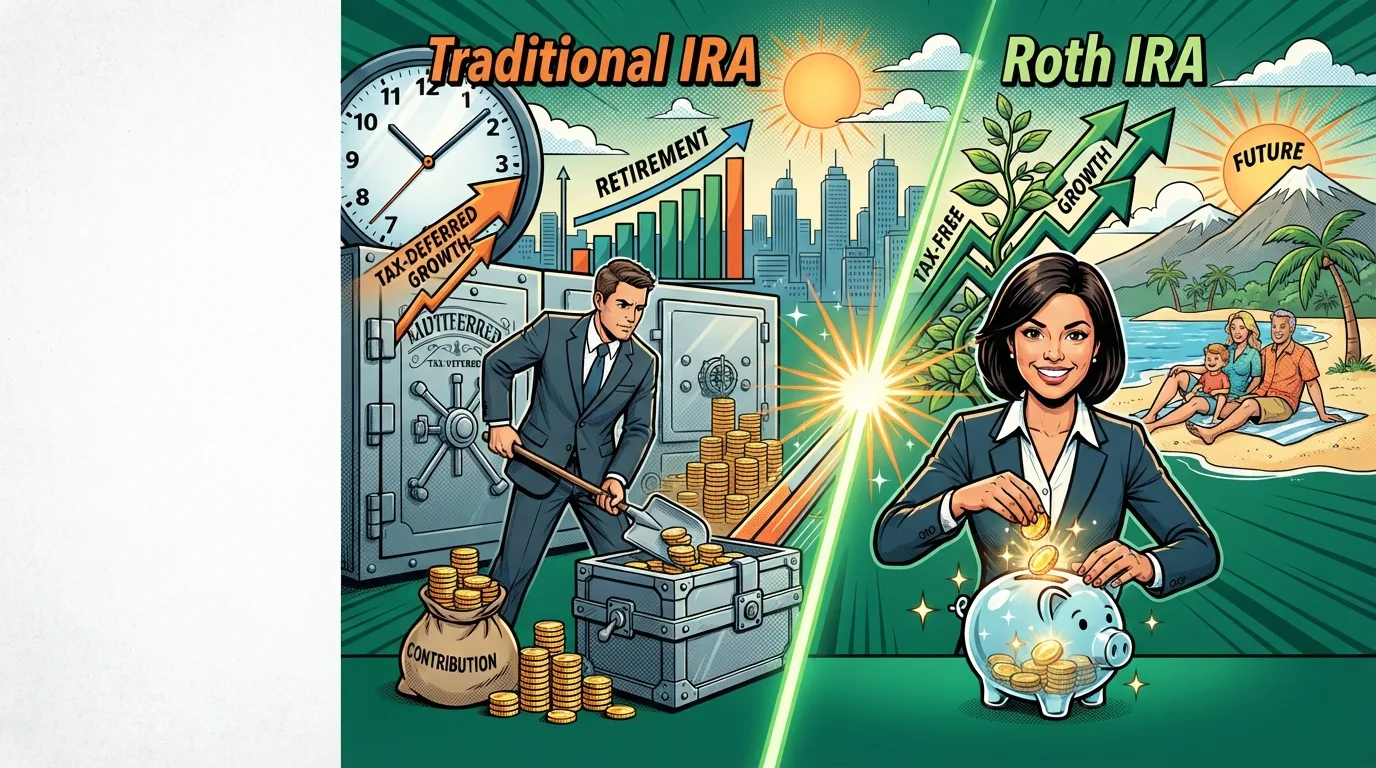
Investing through a retirement account like an IRA or 401(k) provides tax advantages. A Roth IRA is excellent for beginners because contributions are made with after-tax money, and qualified withdrawals in retirement are tax-free. If you have a 401(k) at work, your plan likely offers index funds—check the expense ratios and select the lowest-cost option.
3. Decide your allocation
A simple starting portfolio could be:
- 60% U.S. total market index fund (VTI or ITOT)
- 40% international total index fund (VXUS or FZILX)
Alternatively, use a target-date retirement fund (e.g., Vanguard Target Retirement 2060) that automatically adjusts your allocation as you approach retirement. These funds often consist of a mix of index funds and are an excellent hands-off option.
4. Invest consistently
You don't need a large lump sum. Set up automatic contributions via dollar-cost averaging—investing a fixed amount monthly or bi-weekly. This reduces the emotional impact of market volatility and builds discipline.
Bottom Line
The best index funds are those that combine rock-bottom costs, accurate tracking, and broad diversification. For U.S. exposure, VOO, VTI, and FNILX are top choices; for international coverage, consider VXUS or FZILX. Always evaluate funds within your brokerage context, and prioritize starting early over waiting for the perfect moment.
Index fund investing is a proven strategy for building long-term wealth. By keeping costs low, staying diversified, and maintaining a consistent investment habit, you'll be well on your way to financial independence. Remember, past performance is not a guarantee of future results, but the structural advantages of index funds—low fees and broad diversification—remain powerful tools in any market condition.
Frequently Asked Questions
What is the best index fund for beginners?
For most beginners, the Vanguard S&P 500 ETF (VOO) or its mutual fund equivalent (VFIAX) is an excellent starting point. It has a very low expense ratio (0.03%), tracks a well-known index, and offers instant diversification across 500 of the largest U.S. companies. If you use Fidelity, their zero-fee index funds like FNILX are also top-tier choices.
Are index funds risky?
All investments carry risk, and index funds are no exception. They are subject to market volatility, meaning their value can fluctuate. However, because they hold a broad basket of stocks, they are generally less risky than buying individual stocks. Over long periods, diversified index funds have historically delivered solid returns, but there's no guarantee.
How much money do I need to start investing in index funds?
The minimum investment varies by fund and brokerage. ETFs can be purchased for the price of one share—VOO costs around $450 per share, for example. Many mutual funds have lower minimums, such as Fidelity's ZERO funds ($0) or Vanguard's admiral shares ($3,000). Some brokers also allow fractional ETFs, so you can start with as little as $1.
References