One of the most consequential retirement decisions you'll make is choosing when to start Social Security retirement benefits. The age you claim determines your monthly benefit for the rest of your life — and for your spouse or survivors after you're gone. While the "best" age to claim is different for everyone, understanding the rules, incentives, and trade-offs can help you make a confident, informed choice. This guide breaks down the key factors, including full retirement age, early-claim penalties, delayed-retirement credits, and strategies for married couples.
Understanding Full Retirement Age and Benefit Adjustments
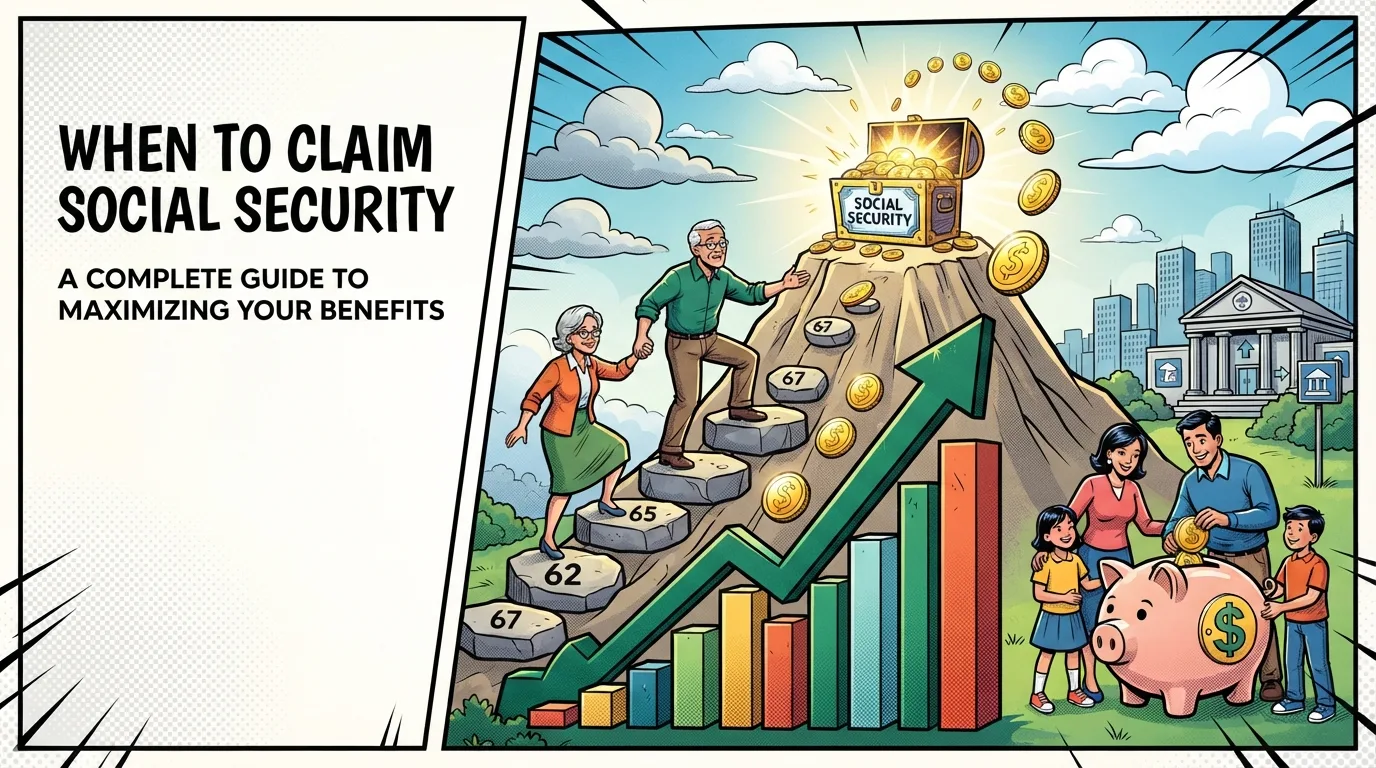
Social Security bases your benefit on your Primary Insurance Amount (PIA), which is calculated from your highest 35 years of inflation-adjusted earnings. You receive exactly your PIA if you claim at your Full Retirement Age (FRA). Your FRA depends on your birth year:
- Born 1943–1954: FRA is 66
- Born 1955–1959: FRA gradually increases from 66 and 2 months to 66 and 10 months
- Born 1960 or later: FRA is 67
Claiming before FRA triggers a permanent reduction. If you start at age 62 and your FRA is 67, your benefit is only 70% of your PIA — a 30% cut. Claiming at 64 gives you about 80% of your PIA. Conversely, if you delay past FRA, you earn Delayed Retirement Credits (DRCs) of 2/3 of 1% per month, which adds up to 8% per year. Waiting until age 70, the maximum delay, can boost your monthly benefit by 24% compared to claiming at FRA.
That difference is significant. For a worker with a $2,000 monthly PIA, claiming at 62 yields $1,400 per month, while waiting until 70 yields $2,480 — a $1,080 monthly gap. Over a 20-year retirement, that delay could mean tens of thousands of additional dollars, depending on how long you live.
The Case for Claiming Early: Why Some Choose Age 62
While claiming early locks in a lower monthly benefit, it can be the right move in several situations:
- Health concerns: If you have a serious illness or family history of shorter life expectancy, the break-even point may be unrealistic.
- Employment barriers: If you've lost your job or can no longer work, starting benefits may be the only way to cover essential expenses.
- Cash-flow needs: Some people simply need the income to avoid tapping retirement accounts at an inopportune time.
- Opportunity cost: If you have a low-earning spouse who will claim spousal benefits later, starting early for the higher earner may provide earlier household income.
Keep in mind that claiming before FRA while still working may trigger the earnings test. In 2025, if you are under FRA for the entire year, Social Security withholds $1 of benefits for every $2 you earn above the annual limit ($23,400 in 2025). If you reach FRA during the year, the limit is higher ($62,100), and the withholding is $1 for every $3 over that amount. Once you hit FRA, benefits are recalculated to give you credit for withheld amounts, but the reduction for early claiming remains.
The Case for Waiting: Why Age 70 Is Often the Optimal Move
For most retirees who have adequate savings, decent health, or a family history of longevity, waiting until age 70 offers clear advantages:
- Higher guaranteed monthly income: Your benefit grows approximately 8% per year between FRA and age 70, a return that is rarely available on low-risk investments.
- Inflation protection: Social Security has a cost-of-living adjustment (COLA), so a higher starting benefit yields a higher inflation-adjusted income stream for life.
- Survivor benefits: If you are the higher earner, waiting can maximize the benefit your spouse will receive after your death, since a widow(er) receives up to 100% of your benefit if they file at their own FRA.
- Longevity insurance: Most people underestimate how long they will live. At age 65, the average woman lives to about 86, and the average man to about 84; a quarter of 65-year-olds live past 90. Waiting ensures you have more income in advanced old age, when health care costs often rise.
Delaying does carry risk. If you die before claiming or shortly after, you may receive less in total lifetime benefits than if you started early. But for a married couple, the survivor benefit calculus often tilts toward waiting, especially for the higher-earning spouse.
How Your Personal Situation Affects the Decision
There is no one-size-fits-all claiming age. Your decision should be based on your own expected longevity, financial needs, and family circumstances. Here are key factors to weigh:
- Life expectancy: Estimate your health status and family history. If you expect to live past your mid-80s, waiting usually pays off in total lifetime benefits.
- Other income sources: Do you have a pension, 401(k), IRA, or rental income? If you can cover essential expenses without Social Security, delaying is more practical.
- Marital status: Married couples face complex rules involving spousal and survivor benefits. Generally, the higher-earning spouse should consider delaying at least to FRA or beyond, while the lower-earning spouse may claim earlier to establish household cash flow.
- Taxes: Up to 85% of Social Security benefits can be subject to federal income tax if your provisional income exceeds thresholds. Drawing from tax-deferred accounts before starting benefits may reduce future required minimum distributions (RMDs) and tax burdens.
- Health care costs: If you retire before age 65, you'll need to fund your own health insurance until Medicare kicks in. Claiming early may help cover those premiums.
Strategies for Couples and Survivors
For married couples, the claiming decision can be optimized for both spouses:
- Spousal benefits: A spouse can claim a benefit equal to up to 50% of the higher earner's PIA at FRA, even if they have little or no work history. The spousal benefit is reduced if claimed before the spouse's FRA.
- Survivor benefits: A widow or widower can claim a reduced survivor benefit as early as age 60 (age 50 if disabled), but taking it before FRA reduces the amount permanently. If the deceased spouse delayed benefits, the survivor may receive a larger benefit.
- The "file and suspend" strategy is no longer available for most people following the Bipartisan Budget Act of 2015, but restricted application for spousal benefits is still possible only for those born before January 2, 1954. Most current retirees should focus on coordinating early versus delayed claims.
A simple rule of thumb: the higher-earning spouse should wait as long as possible (ideally to age 70) while the lower-earning spouse might claim at FRA or earlier if needed. This approach maximizes survivor income, which is especially important for a widow who may live many years without the higher earner's paycheck.
Additional Considerations and Tax Timing
Your filing age also affects your taxable income and Medicare premiums. Income-related monthly adjustment amounts (IRMAA) can increase your Part B and Part D premiums if your modified adjusted gross income exceeds certain thresholds. A one-time large Roth conversion or capital gain before you claim might raise your premiums for two years, so planning the order of income sources is wise.
Moreover, working while claiming early can result in withholding, but those amounts are not lost. After you reach FRA, Social Security recalculates your benefit upward to account for benefits withheld, although the early-claim reduction remains.
Bottom Line
Choosing when to claim Social Security is a key retirement planning decision with long-term consequences. For most single retirees in good health and with financial reserves, waiting until age 70 is the mathematically optimal choice because it delivers a higher inflation-protected income stream and protects against outliving your savings. However, if you have health doubts, need immediate income, or can invest early benefits wisely, claiming at 62 or in between may be sensible. Married couples should pay special attention to survivor benefits, often making it worthwhile for the higher earner to delay while the lower earner claims earlier. Before deciding, review your own financial plan, consult a financial advisor or use the SSA's online calculators, and revisit your decision annually as your circumstances evolve.